Sesame Summit 2026 – application open

Ben’s List for Entrepreneurs W53 – Selected

With the year coming to an end – (but wait, there’s still week 53 and a new mutation of the virus ‍♀️ ‍♂️) we thought it would be interesting to check again on the recent articles and ideas that I shared on a weekly basis for the past 2 months.

Technically it’s not really my 2020 reading list, but it gives you a bird eye’s view of what my brain is usually busy with. These are the things I find interesting and valuable, hopefully you do too.

Unsurprisingly, I dove into everything related to the launch of Selected by Sesamers lately. So a lot about community, newsletters, marketing and social media. The bread and butter of any business nowadays.

I also entertained my mind with literature, neuroscience and a bunch of exotic concepts around quantum mechanics. A few are shared below.

My top advice to those reading this last article of 2020:

Take the time to be a better manager and infuse the right strategy within your organization.

My New Year’s Resolution is to improve in these areas in 2021.

And to keep sharing what I learn along the way.


COMMUNITY

1. How to Launch an Online Community — Lean Community Launch Framework

Community isn’t just another word for audience. It’s a special space you create for your most engaged members to gather and interact.

blank
Credit: Ludovic Célérier 
  • Link: yenfm.substack.com/p/how-to-launch-an-online-community
  • Author: John Saddington
  • Source: Yen.fm

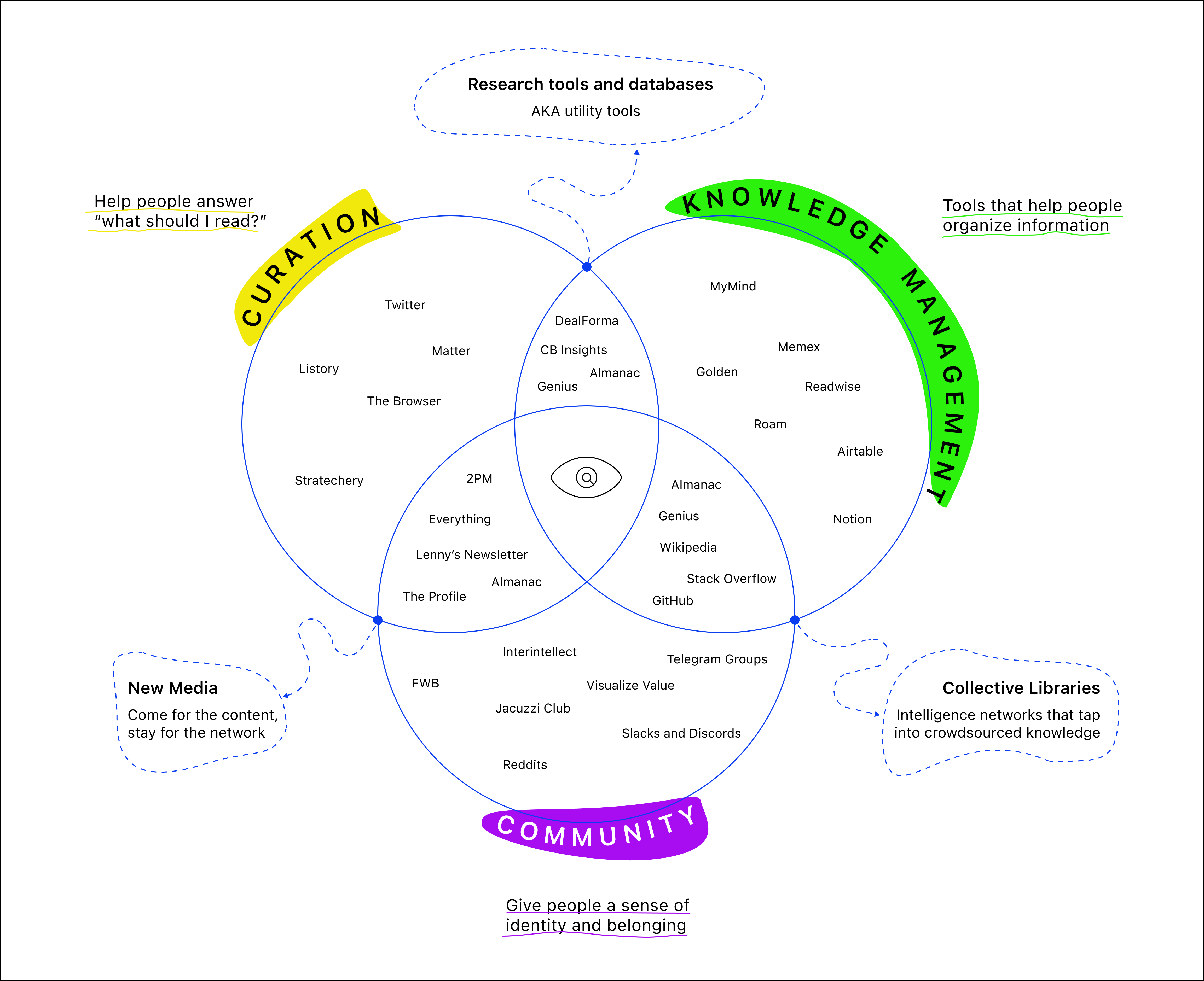
2. Big trend: online communities at the intersection of content curation and knowledge management

We are living through the emergence of a new business category that doesn’t even have a name yet, but which I believe will become an important part of our digital lives: online communities at the intersection of content curation and knowledge management.

This is EXACTLY what we’re aiming for with Selected
blank
Credit: Sari Azout / Check Your Pulse

CUSTOMER SUPPORT

Diagnosing Symptoms of Success

Here’s one for you on-the-go.

Dive into Kaizo’s podcast with Talixo’s Jan Brenneke as he shares his expertise in the application of analytics & metrics in the context of Customer Service and it’s intersection with management science.

blank
Credit: @KaizoHQ

LITERATURE

To Believe in Things: Poet Joseph Pintauro’s Lost Love Poem to Life, Illustrated by the Radical Nun and Visionary Artist Sister Corita Kent

You are not everything but everything could not be everything without you.

I shared this with Dan. He cried

blank
Credit: BrainPickings

MARKETING

Your Marketing Org is Slow. Here’s a framework to move faster.

I’m always an advocate of “done is better than perfect” and I believe that it’s even more the case with marketing. Conveying your story to the right audience is timely. Sometimes it’s a matter of hours for a campaign to become irrelevant to the cultural context.

blank
Credit: First Round Review

MANAGEMENT

1. Successful Remote Teams Communicate In Bursts

We started to experiment with flex hours after 2 months of working from home. It means that we are all on deck from 10am to 3pm.

I can confirm that “burstiness” works very well for a small teams like ours. It involves agreeing on some work routines that allow everyone to respond to messages fast and have short and intense periods of communication.

blank

2. The Psychology of Focus: How Great Teams Find Traction Amid Distraction

In this podcast, NFX General Partner James Currier sits down with Nir Eyal, author of Hooked and Indistractable to analyze what high performing teams are doing right in a world full of distractions.

blank
Credit: NFX

NEUROSCIENCE

Altered states of consciousness: the elusiveness of the mind

Maybe instead of considering a default state and a myriad of altered states, we need to contemplate the possibility that all these states of consciousness are all equally important modes of perception.

blank
Credit: ScienceFocus.com / James Kingsland

NEWSLETTERS

The best newsletters to follow on European tech

Startup News, Weekly Roundups, Data, Deeptech, … and the list goes on. Great compilation. Now if only they had an Events category …

blank
Credit: QuickMeme

SOCIAL MEDIA

LinkedIn’s Alternate Universe

And I quote:

LinkedIn is the fucking worst.

Especially considering the basic fact that…

If you have a job, you might lose it. If you don’t, you might find one. So, we stay. Even if it sucks. LinkedIn is bizarre because it tries to make this hostage situation fun. Even though it’s not.

blank

STRATEGY

Build a Network of Ideas, People & Products

Jack Butcher, founder of VisualizeValue walks us through his thoughts and process of finding people you can help, and building products that help them.

Ideas -> People -> Product.


VENTURE CAPITAL

1. Why investors are betting on Silicon Valley’s second climate boom

If the U.S. Presidential election showed us nothing else, Climate Change is now back on the agenda at The White House. It’s on The Valley’s list too.‌

blank
Credit: Quartz

2. The VC “Strips off” – Silicon Roundabout Ventures VC Fund Deck Reviewed Live by Draper Esprit LP

From a network access perspective, being able to access an engaged community is not just a “nice to have” but really a “must have”.

blank
Credit: Dilbert (dilbert.com) – Tuesday July 10, 2012

ZOOMITIS

Home Screens: Quarantine is the future big tech wanted us to want. How long before we want out?

Before the pandemic, tech companies treated space as an annoying set of limitations to be overcome by apps

blank
Image: Every Way You Turn (2019) by Aaron Elvis Jupin

Users experience Zoom more as a stultified form of virtual reality than an augmented one, because it now feels like there’s little off-screen reality available to augment


SEASONAL

Eight hours of 4K footage and ASMR audio of a cozy fireplace

Because when you can’t have an actual fireplace, this is the next best thing

you might also like

Event strategy for VC

When I started working in VC, conferences were treated as a nice extra. Something you sprinkled on top of a sourcing strategy that lived elsewhere, often in a partner’s address book. Being an investor meant you mainly had to spend a few days out of the office per week for dealflow meetings, you attended the occasional panel slot if you had a friend on the programme team, shared a few tweets and that was it. But today conferences are part of the core marketing infrastructure that keeps the firm in the flow of founders, operators, LPs and peers. These events act as a pretext to re-engage with warm or cold leads, whether a fund is at the beginning of their investment cycle or deep in fundraising for their next flagship fund.  Every tech city has its own flagship event. If you are a generalist VC, chances are you can easily identify 20 conferences that you are expected to show up at, and 40 that you could attend.  So, where do you start? How do you really decide whether it’s a good reason to attend? Most investors only see the tip of the iceberg: the logo of the headline conference. They rarely see the resource constraints that come with executing the field work. That tension creates too familiar operational dramas for marketing teams, including last-minute “Where is my ticket?” message, partner demands for main-stage slots, and the flurry of FOMO driven interest because another prestigious fund has been announced as a partner. And yet, despite common belief, investors don’t attend conferences for the parties.  When I look at the 100 plus conferences I have attended over my career, I tend to group the real reasons into 10 buckets. 1. Qualified dealflow Good conferences act as magnets. They pull in the startups that are relevant for a specific thesis, geography or stage. For generalist VCs, niche events are a way to see a concentrated sample of the market in two days. For more specialist firms, these events are a way to go deeper into a vertical, and to be visible in that niche. 2. On-the-shelf networking Conferences provide “on the shelf networking”: the infrastructure of meetings, lounges, apps and social events is already built. You simply step into it. For investors, that is valuable across several fronts: they can connect with  founders and future founders, operators for senior hires, practical experts and   LPs exploring new funds.  3. LPs and the (secret) permanent fundraise Most funds are always fundraising. Events that attract LPs are therefore particularly attractive. Even a handful of good LP conversations can justify several days out of the office, especially if this involves underground Berlin (Super Return) or a roundtrip to the French Riviera (IPEM).  4. Media relationships Some partners only have meaningful conversations with journalists at conferences, mainly because engaging with the media is not part of their day-to-day routine. For them, conferences provide an efficient way to concentrate press engagement in one place without having to pitch themselves. For marketers handling complex logistics across several markets, an event is often the one moment where the stars align. 5. Thesis signalling Good investors have local-based theses and want to attract dealflow consistently across several years, whether or not they have cash to invest. Attending Stockholm-based conferences is a way to say, “we are serious about the Nordics” without having to buy billboards in the airport (although some folks do exactly that). In that sense, VCs and event organizers are sometimes competing as community enablers. Both are trying to become the natural node for a given ecosystem. 6. Speaking and thought leadership Speaking slots are a form of social currency in venture – and comes with a few perks such as “speaker dinners”. Many partners enjoy being on stage and the status premium associated with it. I guess there’s a reason why some people are more interested in how they will look like on their Slush stage picture than what they are going to say. Beyond ego, speaking opportunities give VCs a platform to articulate their thesis, test a narrative in front of a live audience, and attract founders at the very top of the funnel. Some of the best inbound I have seen has come within a week of a talk. A founder who heard a line and followed up. A journalist who spotted a quote for a later story. Someone who waited backstage with a pitch. This is part of why VCs can be VERY intense about speaking slots. From their perspective, stage time is not simply a visibility perk. It is a key input into the marketing engine. 7. Curation Some conferences have a strong reputation for curation. You trust that if you turn up at TEDx, DLD, or similar events, you will be challenged and inspired. For investors who spend most of their year buried in spreadsheets, this is attractive. Alas, I think the content quality has nosedived these last couple of years so it’s less true. 8. Portfolio support Serious investors use conferences to help portfolio companies with commercial introductions, support them on talent hunting, offer stage visibility and access to LPs, journalists, and peers. When a portfolio company is having a big moment, everything else tends to rearrange around it.  9. IRL experiences Many VC franchises have grown used to operating digitally. What is often missing is a reliable in person interface for the broader community around the fund. Conferences solve this by using those moments to crystallise the community you are building.  A simple breakfast, an LP catching up with several of your founders in one afternoon: these are small touches, but repeated over ten years they are part of how trust compounds.  10. Watching to competition Conferences are one of the few places where you can literally see how competitors behave with founders, with LPs, with the media and with each other. Who is always surrounded by founders. Who is quietly building a niche. Who is sponsoring heavily in a

Rift raises €4.6M for aerial reconnaissance platform
Fundraising 4 months ago

Europe’s defence technology sector is witnessing unprecedented investment momentum, driven by shifting geopolitical realities and increasing demand for autonomous surveillance solutions. At the forefront of this transformation sits Rift, a Paris-based startup that has just secured €4.6 million in Series A funding to build Europe’s first on-demand aerial reconnaissance network. The round was led by AlleyCorp, the New York-based venture firm known for backing enterprise technology companies. This investment signals growing transatlantic interest in European defence tech capabilities, particularly as NATO allies prioritise technological sovereignty and autonomous reconnaissance systems. AlleyCorp leads aerial reconnaissance funding round AlleyCorp’s decision to lead this round reflects a broader strategic shift among US investors towards European defence technology startups. The firm, which has previously backed companies like MongoDB and Paperless Post, sees significant potential in Rift’s approach to democratising aerial intelligence gathering across civilian and military applications. “Rift’s technology addresses a critical gap in the European surveillance market,” noted a spokesperson from AlleyCorp. “Their ability to deploy on-demand reconnaissance missions using autonomous systems represents exactly the kind of dual-use innovation we expect to define the next decade of defence technology.” The investment comes at a time when European governments are accelerating defence technology procurement, with the EU’s European Defence Fund allocating €8 billion for collaborative defence research and development programmes. This regulatory tailwind positions Rift advantageously within a market expected to reach €24 billion by 2027. Building Europe’s autonomous surveillance network Rift’s platform combines advanced drone technology with artificial intelligence to provide real-time reconnaissance capabilities across multiple sectors. Unlike traditional surveillance methods that require significant infrastructure investment, the company’s on-demand model enables clients to access aerial intelligence through a software-as-a-service platform. The startup plans to use the funding to expand its autonomous fleet and enhance its AI-powered analytics capabilities. With operations currently focused on France and Germany, Rift aims to establish coverage across major European markets by 2026, positioning itself as the continent’s primary alternative to US-based surveillance providers. “European organisations need surveillance solutions that comply with GDPR and other regional privacy regulations,” explained Rift’s CEO. “Our platform is built from the ground up with European data sovereignty in mind, something that resonates strongly with both government and enterprise clients.” This funding positions Rift to compete directly with established players like Palantir and Anduril, whilst offering European clients the regulatory compliance and data localisation they increasingly demand. As defence technology becomes increasingly intertwined with civilian applications, Rift’s European-first approach may prove to be its strongest competitive advantage.

energy infrastructure funding, grid technology investment, BESS funding
Fundraising 4 months ago

Europe’s energy infrastructure is undergoing its most significant transformation since electrification began. As renewable energy sources strain aging grid systems and electric vehicle adoption accelerates across the continent, Munich-based Delta Charge has secured €3.7 million to address critical gaps in energy storage and distribution. The funding round, led by Vireo Ventures and Rethink Ventures, positions the startup to capitalise on Europe’s urgent need for battery energy storage systems (BESS) and grid modernisation solutions. This investment reflects growing European investor confidence in energy infrastructure startups as the EU accelerates its transition to renewable energy sources. With the European Green Deal mandating carbon neutrality by 2050, the timing couldn’t be more strategic for Delta Charge’s market entry. Energy infrastructure funding attracts European climate tech investors Vireo Ventures and Rethink Ventures bring complementary expertise to Delta Charge’s growth trajectory. Vireo Ventures, known for backing transformative European climate technologies, sees Delta Charge as addressing fundamental infrastructure challenges that traditional utilities struggle to solve efficiently. Meanwhile, Rethink Ventures’ portfolio focus on sustainable technology solutions aligns perfectly with the startup’s mission to optimise energy distribution networks. “We’re witnessing unprecedented strain on European energy grids as demand patterns shift dramatically,” explains a Vireo Ventures partner familiar with the investment decision. “Delta Charge’s approach to battery energy storage systems offers the scalability and intelligence that Europe needs to maintain grid stability while integrating renewable sources.” The investor combination signals strong European institutional support for energy infrastructure innovation. Both funds have demonstrated expertise in scaling climate tech companies across fragmented European markets, providing Delta Charge with strategic value beyond capital injection. BESS technology targets European grid modernisation Delta Charge’s battery energy storage systems address acute European challenges that differ significantly from other global markets. The continent’s diverse regulatory frameworks, varying grid infrastructures, and ambitious renewable targets create unique technical requirements. The company’s technology optimises energy storage placement and management across these complex, interconnected networks. The €3.7 million funding will accelerate product development specifically for European market conditions and support expansion across key markets including Germany, France, and the Netherlands. Delta Charge plans to leverage regulatory tailwinds from the EU’s REPowerEU initiative, which prioritises energy independence and grid resilience investments. “European energy markets present both immense opportunity and distinct challenges,” notes Delta Charge’s leadership team. “Our BESS solutions are designed specifically for the regulatory complexity and infrastructure diversity that characterises European energy systems.” The startup’s technology addresses critical pain points including grid balancing during peak renewable generation periods and energy storage optimisation for commercial and industrial applications. With European electricity prices remaining volatile and grid stability concerns mounting, Delta Charge’s timing appears particularly astute. This funding round exemplifies the European venture capital community’s increasing focus on infrastructure-critical climate technologies. As European governments commit billions to energy transition initiatives, startups like Delta Charge are positioned to capture significant market opportunities whilst addressing urgent societal needs.

Subscribe to
our Newsletter!

Stay at the forefront with our curated guide to the best upcoming Tech events.