
Sesame Summit 2026 – application open

BiteMe Nutrition: Indulgent, Healthy Snacks

“Healthy indulgence” is a rising trend in sports nutrition and beyond. This is where Croatian startup BiteMe fits in with its healthy and tasty snacks. 

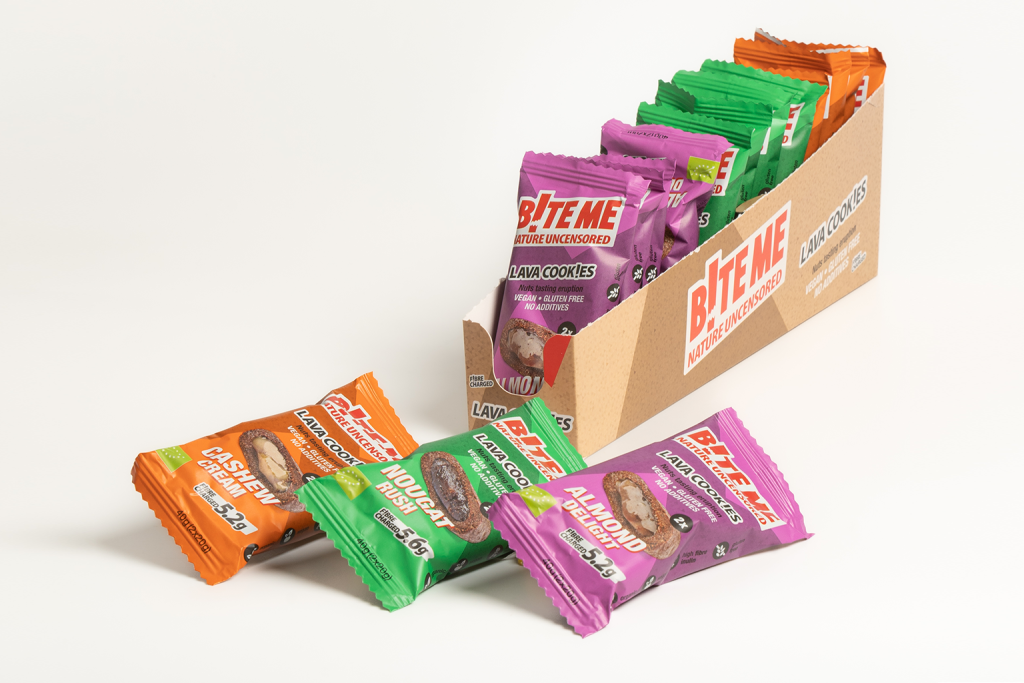
Its main products are raw bars, protein cookies and lava cookies that are vegan, organic, plant-based, gluten- and additive-free; but by its own claim, also “so tasty you’d think they’re not healthy.” That’s only appearance, though.
blank

A Rebellion Against Unhealthy Industry Practices

Although BiteMe’s products fall under snacking, a habit that consumers won’t quit any time soon, the company was founded in 2019 as an answer to what it sees as the industry’s unhealthy practices — artificial sweeteners, refined sugars, additives, etc.

“To that we said “bite me”, we can do it better, so in a way our name is like a rebellion against the industry’s unhealthy practices,” its team explained. In practice, this means centering on “natural, understandable ingredients.” 

blank

Joyful Snacking: No Compromises on Taste or Health

In line with its name, BiteMe’s brand positioning is also modern and lighthearted, with a sense of fun. Seeing the current healthy snack category as lacking excitement, emotion, and true natural indulgence, it decided to answer with “joyful snacking” — without compromises on taste or health.

Its team also reflects this multifaceted goal. Part of Zagreb Innovation Centre, it consists of two athletes, one food technologist, and a business person. All of them consider themselves health-conscious snackers and active, but their target audience is broader.

“BiteMe was designed for consumers who reject unhealthy snacking choices, or for those that simply seek to enjoy a convenient healthy bite on-the-go,” the company said. By framing its snacks as a break in a busy day “for emotional well-being and indulgence,” it hopes to empower more consumers to make better dietary choices.

blank

Competing in the Healthy Snack Market

BiteMe’s raw bars have some high-profile competitors that also position themselves as healthy, such as Nakd, Rawbite, Roobar, and RXBAR. However, the fact that it differentiated beyond bar-shaped products gives it an edge. Per its team: “We make cookies with soft filling, which bring more excitement and joy while eating.”

This is resonating with consumers, with BiteMe’s e-commerce sales growing steadily, and potentially having an important role to play in the future. 

blank

BiteMe’s Growing Presence in Europe

In the meantime, the good news is that B2B buyers, too, seem to have a good grasp of its value proposition: BiteMe said its products are already sold in some 2,200 sales points across Europe, including retail, bio stores, drugstores and some sports channels. 

It hopes to use its participation in SIAL Startup Invest to find new business partners, but also to meet investors and like-minded food enthusiasts who understand that health and indulgence can coexist.

blank

you might also like

FINTECH 1200x650 1
Fundraising 1 day ago

London fintech Outpost raises $17.5M Series A led by Ribbit Capital to scale its AI-powered merchant-of-record platform, simplifying cross-border payments, tax, and compliance for global merchants.

AI fintech funding
Fundraising 2 days ago

The European fintech sector continues to attract early-stage capital, with AI-powered financial modelling emerging as a particularly active frontier for investor interest. As finance teams across high-growth organisations grapple with the limitations of static spreadsheets and fragmented planning tools, a new generation of startups is building intelligent infrastructure to replace legacy workflows. Stockholm-based Galdera Labs has now entered this space with a €1.5 million pre-seed round to develop an AI-native financial modelling platform designed for growth-stage finance teams. The funding will support platform development, reasoning infrastructure buildout, and an initial customer rollout targeting fast-growing companies with complex financial operations. Galdera’s platform combines a high-performance calculation engine with a semantic memory layer that links financial data directly to underlying business context, assumptions, and strategic decisions — enabling finance teams to query models in natural language and simulate complex scenarios in minutes rather than weeks. Klarna Veterans Back AI Financial Modelling Vision The pre-seed round was led by J12 Ventures, with participation from Antler and a roster of angel investors drawn from notable European technology companies including Klarna, DeepL, Stripe, and Plata. The investor composition reflects strong confidence in the founding team’s pedigree and the market opportunity for intelligent financial planning infrastructure. Galdera’s three co-founders — Evan Rumpza (CEO), Mattia Scolari (CFO), and Giovanni Casula (CTO) — met at Klarna during the fintech giant’s most intensive growth phase. Responsible for financial planning across 26 markets, the team experienced first-hand how manual processes and fragmented Excel models struggled to keep pace as business conditions shifted faster than traditional models could be rebuilt. To manage the complexity, they built an internal system at Klarna that replaced the static planning cycle with a continuously updated model — enabling what previously required large analyst teams to be handled by just three people, supporting the company through both capital raises and IPO preparations. The lessons learned from that experience became the foundation for Galdera Labs. “We’ve personally sat with 50 spreadsheets at two in the morning using tools that were supposed to solve the problem but didn’t. That is the infrastructure we are building with Galdera,” said Evan Rumpza, CEO and co-founder of Galdera Labs. Building AI Finance Tools for the Next Generation of CFOs The market for AI finance tools and financial modelling software is evolving rapidly as organisations demand more dynamic planning capabilities. Traditional spreadsheet-based approaches, while flexible, often create fragmented workflows where assumptions become outdated and institutional knowledge is lost between budget cycles. Galdera’s platform addresses this gap with a two-layer architecture: a powerful calculation engine capable of handling large data volumes, paired with a semantic memory layer that preserves the reasoning behind financial decisions over time. The platform is designed to function as an always-on financial forecast that automatically updates as business conditions change. Users configure scenarios once, and the model recalculates impacts across revenue, costs, margins, and other key metrics in real time. This approach positions Galdera within a growing wave of European fintech startups applying artificial intelligence not merely as an overlay on existing tools, but as a foundational redesign of how financial planning operates. With the launch, Galdera is opening its platform to its first customers: fast-growing companies and organisations with complex operations where the pace of decision-making has outgrown the tools finance teams traditionally rely on. Early adopters already include companies such as DeasyLabs, Unify, and Counsel. The pre-seed round positions Galdera Labs at an early but promising stage in a sector where demand for intelligent, context-aware financial infrastructure is accelerating across European markets. As AI continues to reshape enterprise workflows, the intersection of financial modelling and machine reasoning represents a significant opportunity for startups capable of delivering genuine operational value to scaling businesses. Summary

AevoLoop circular plastics recycling technology funding announcement with plastic waste processing
Fundraising 2 days ago

The sustainable consumer goods sector is witnessing growing investor appetite as environmentally conscious brands prove they can combine purpose with profitability. East London-based Allday Goods, the cult kitchen knife brand that transforms plastic waste into chef-quality blades, has raised £765,000 in a seed round led by FIGR Ventures to scale its operations from artisan favourite to mainstream kitchen staple. Founded in 2021 by ex-chef Hugo Worsley, Allday Goods manufactures kitchen knives with handles crafted entirely from recycled plastic waste — sourced from Maldon Salt buckets, milk bottle handles, discarded plant containers, and fishing nets washed up on British shores. The brand, which started in Worsley’s parents’ shed using a repurposed toastie maker, has already achieved profitability with minimal external investment. Products consistently sell out within minutes during online drops, and queues have formed at London pop-ups, reflecting a level of consumer demand that few sustainable brands can match at this stage. FIGR Ventures Leads Seed Round with Sustainability-Focused Backers The £765,000 round was led by FIGR Ventures, with participation from Anotherway Ventures, Machroes Holdings — the family office of Lord Mervyn Davies — and angel investor Tom Gozney, founder of the premium pizza oven brand Gozney. The investor mix signals confidence in Allday Goods’ ability to bridge the gap between sustainable manufacturing and scalable consumer product design. Allday Goods’ knives pair handles made from 100% recycled food-grade polypropylene with British and Japanese steel blades. The company collects, cleans, shreds, and remoulds plastic waste into distinctive, colourful handles that carry visible traces of their former lives — a design choice that has become central to the brand’s identity. Each knife effectively diverts plastic from landfill whilst delivering professional-grade performance. Worsley commented on the raise, noting that the team had built the brand slowly and intentionally, and that securing backing from investors they genuinely admire represents a significant milestone for the next chapter of growth. From Cult Following to Mainstream Market Opportunity Allday Goods has already demonstrated significant commercial traction without substantial marketing spend. The brand’s high-profile collaborations with Ottolenghi, Soho House, Maldon Salt, Kerrygold, and Paul Smith have positioned it at the intersection of culinary craftsmanship and design culture. Features in The World of Interiors and Esquire have further cemented its reputation among discerning consumers who value both aesthetics and environmental responsibility. The fresh capital will be deployed to scale production capacity, expand the product range, and accelerate the transition from limited-edition drops to consistent retail availability. The challenge for Allday Goods will be maintaining the artisan quality and brand mystique that fuelled its cult status whilst meeting the demands of a broader consumer base — a tension that many direct-to-consumer brands have struggled to navigate. The broader sustainable kitchenware market continues to attract both consumer interest and investor capital across Europe. As regulatory pressure on single-use plastics intensifies and consumers increasingly seek products that align with their environmental values, brands like Allday Goods that demonstrate genuine circularity in their manufacturing processes are well-positioned to capture meaningful market share. Summary Company: Allday GoodsHeadquarters: East London, United KingdomFounded: 2021Founder: Hugo WorsleyRound: SeedAmount: £765,000Lead Investor: FIGR VenturesOther Investors: Anotherway Ventures, Machroes Holdings, Tom GozneyUse of Funds: Scale production, expand product range, transition to mainstream retail availability

Subscribe to
our Newsletter!

Stay at the forefront with our curated guide to the best upcoming Tech events.